
Download this guide as a pdf (254Kb).
Every year in Australia it is estimated that 320,000 children under the age of 15 are treated in hospital as a result of accidents, many of which are sustained within their homes. Children under five are most at risk.
The majority of accidents are preventable through simple precautions such as isolating hazards (e.g. poisons and medications) or installing safety products to guard against them (e.g. stair gates).
Nothing is as effective as active adult supervision in preventing child injuries within the home.
This Home Safety Guide has been prepared by Homesafe Kids a division of Homesafe Group Pty. Ltd. in conjunction with Kidsafe and The Victorian Injury Surveillance Unit to assist you to identify and prevent potential injury to children from hazards within your home. Australian injury figures were estimated from Victorian data provided by the Victorian Injury Surveillance Unit (VISU).
Do It Yourself Child Home Safety Guide
Equipment You Will Need
To undertake your own child home safety assessment you will need some basic equipment. If you are not confident and would rather have a professional assess your home, Homesafe Kids can undertake a low cost professional assessment for you.
- A thermometer
- A step ladder
- A power point tester
- A tape measure/ruler
These items can be purchased from your local hardware store.
One component you may not be able to self-assess is accessible glass. An estimated 3,600 children in Australia sustain serious glass cut injuries, many from window and door glass. It is critical to ensure that accessible glass is safety rated or reinforced against impact. Homesafe Kids inspections show that 25% of Australian homes have unsafe glass situations.
Heat treated safety glass is relatively easy to identify by a mandatory permanent ceramic ‘label’ fired into one corner of the pane. This can be subtle so close inspection may be required. Laminated safety glass is more difficult and can only be identified by confirming its thickness to be 6.38 mm. A professional glazier or Homesafe Kids assessor can do this for you.
External
There are many dangers lurking in the backyard and front yards of most Australian homes. Some of these are obvious; others will be a surprise to most parents.
Sheds & Garages
Sheds and Garages harbour many dangers such as poisoning from chemicals and injuries from tools. Take the following precautions to keep children out when you are not with them and safe when you are.
- Ideally, the shed should have a self closing door and a latch mounted no lower than 1500mm. If this is not possible, make sure it is locked.
- Ensure that all pesticides, paints, chemicals and other poisons are stored in tightly covered, labelled, original containers at least 1500mm off the ground, out of the sight and reach of children.
- Ensure that all tools are locked away.
Driveways
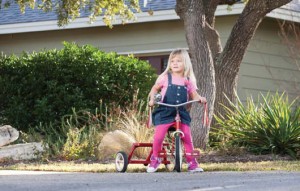 Driveways are extremely dangerous for young children; they are designed for vehicle access to properties and pose similar dangers as roads. All vehicles have restricted rear vision making toddlers difficult to see. On average one child each month is killed in driveway run over incidents and many more suffer severe injuries. Most of these incidents occur at the child’s home with the driver usually being a parent or relative.
- Children’s play areas must never open onto driveways
- Doors opening onto driveway areas should have latches or handles no lower than 1500mm
- Set up a safe play area for your children, away from hazards such as driveways. Your Homesafe Kids assessor can help you do this.
Fencing
Fences should be secure to prevent children gaining access to neighbouring properties.
- Ensure there are no climbable trees adjacent to fencing
- Centre rungs should be topped with triangular quad to prevent climbing
- Routine inspection should be carried out to remove exposed nails
Water
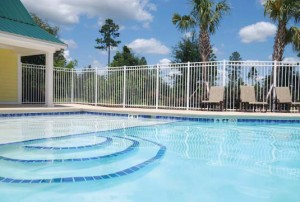 Swimming pools and spas capable of holding more than 300mm of water are required to be surrounded by an Australian Standards compliant safety barrier with a self closing and self latching gate. This includes inflatable swimming pools which can be purchased from your local department store. In most states and territories there are considerable fines for non compliant pool fences and defective gate latches. Check with your local council or Kidsafe office for more information on the legislation and safety barrier requirements in your area.
- Remove any climbing opportunity that might provide access to the pool, for example pot plants, outdoor furniture and BBQs.
- Ensure that all gates and doors leading into the pool are shut. An open door or a propped open gate might seem convenient for adults, but could be lethal for children.
- Display a resuscitation poster beside pools in case of drowning.
- Conduct regular maintenance and safety checks on pool fencing and gates to ensure that they are in proper working order.
Water features and ponds can also pose a drowning hazard for children; consider draining water for the duration of the toddler period otherwise cover ponds with wire mesh or a metal grate to restrict access to the water.
Water tanks and makeshift water storage containers have been installed in many Australian houses during the drought. Open drums, wheelie bins and buckets used to store water are potential drowning hazards and should not be accessible to children.
Play Equipment
Play equipment should be strong, stable and in good condition; regular maintenance checks are required to ensure that there is no damage such as rust and that the equipment is safe for use.
- It is recommended that play equipment should comply with the Australian Standard AS: 4685:2004.
- A soft impact absorbing surface should be installed under play equipment over 500mm high to cushion falls. It is recommended that the surfacing is maintained to a minimum depth of 300mm.
- Play equipment should not have sharp edges, entrapment hazards, splintered timber or protruding components that could pierce skin, or tangle children’s clothing.
- Remove loose clothing or clothing with cords.
- Sandpits should be covered when not in use to avoid contact with animal faeces.
Vegetation
 Toxic plants can cause illness and even death in some instances. Parents should be aware of toxic plants that may be present in the garden. Homesafe Kids inspection statistics show that approximately half of Australian gardens have plants listed as toxic.
- The most dangerous of these are oleanders, trumpet lilies, castor oil plants and toadstools which can be fatal if ingested. These species should be removed or isolated.
- Azaleas, rhododendron and poinsettias can cause illness and may be the cause of unexplained poisoning symptoms in toddlers.
- Rhus and Poison Ivy will cause severe skin irritation
Your local nursery will be able to assist you to choose child friendly plants to include in your garden.
For more information on poisonous plants contact your local Kidsafe office, local nursery or the Poisons Information Centre on 13 11 26.
Pets
Family Pets can cause injury by biting or disease through contact with faeces. Homesafe Kids inspections show that 10% of Australian homes have a dog/child separation danger. This can be addressed by creating a safe play space for children remote from pets eating and sleeping environments.
Electrical Switchboards in all recently built homes are protected by residual current devices (RCD) in accordance with building regulations. An RCD is a finely tuned safety switches that senses any power surge or drain and immediately cuts the power supply. If your home is not protected by an RCD you should consult an electrician immediately to have one installed. Meanwhile, ensure that all power points are protected using plastic power point inserts.
Internal
Some off the shelf products purchased from hardware chains may not provide a satisfactory solution, will often result in unnecessary damage to walls, cupboards and furniture and could create more dangers. The Homesafe Kids website has many useful tips on selecting and installing products.
Parents and grandparents often attempt to “toddler proof” their entire home but find the cost exorbitant. Your Homesafe Kids assessor can advise how to set up “child safe zones” that provide maximum safety and supervision for minimum cost.
Child Safety Zones are a cost effective method of protecting toddlers.
- Use safety gates or exclusion barriers to create an area typically comprising the child’s bedroom, passage and family room which can be supervised from the kitchen or family room.
- Obtain advice on which products to use. Typically safety gates are recommended for toddlers up to 24 months however better quality products will be effective for more than double that time. Inappropriately configured products will damage walls and cupboards while others cannot be securely fixed to some wall surfaces.
- Once the safety zone has been isolated, address all safety issues within it including sharp corners, unstable furniture, cupboard contents, power points, low level glass, etc.
- Doors, particularly those on children’s bedrooms can cause severe finger injuries. An estimated 4000 children are treated in hospitals in Australia each year after jamming fingers in doors, commonly the hinge side. Serious injuries include fractures, nerve damage and amputations. To reduce the risk of this hazard, fit finger jam protectors to doors in the child safety zone.
Windows
Windows are responsible for many child accidents.
- Windows panes in older homes may not be safety glass. These could shard if impacted. Establish the status of the glass as discussed earlier in this guide and consider re-glazing with safety glass or applying window security film as a less expensive option. Your Homesafe Kids assessor can install window film for you
Eye level graphics can also be used to alert children to glass in low windows and doors.
- Accessible upper level windows can result in falling injury if not restrained. Sashless double hung windows are of particular concern because their counterbalanced nature renders them easy to open. Most insect screens are designed to keep insects out and unless security rated will not act as a physical barrier to prevent access. Windows should be fitted with guards or stops to prevent them opening wider than 125mm. Your Homesafe assessor can install these.
- Loose curtain and blind cords, particularly those with loops can strangle young children. These should be shortened and restrained against the window frame with cleats or cord tensioning devices.
Fire Safety
Fire Extinguishers and Fire Blankets are necessary in every home and should be installed on the egress side of your kitchen appliances. Your Homesafe Kids assessor can provide and install these for you. Statistics show that fire can result from a parent being distracted by a needy toddler. If fire breaks out, you should first smother the flames
with the fire blanket, turn off the fire source if it is safe to do so then use the extinguisher on any visible flames. If the fire continues to burn, gather children and evacuate immediately. Everyone should develop and regularly practice a fire evacuation plan particularly for double storey houses where stairs could be blocked.
Smoke Detectors save lives. Install smoke alarms immediately outside all bedrooms. Observe instructions to avoid locating in ‘smoke shadow’ areas. Test alarms monthly to ensure that they are in working order, and replace batteries annually.
Heating
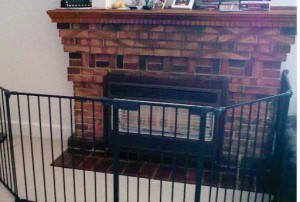 Heaters such as radiators, slow combustion and space heaters are all dangerous and a major cause of burns injuries. Wall furnaces are generally safe however older models may emit sufficient heat to cause injury. Restrict children’s access by totally isolating the heater with an exclusion barrier until the child is old enough to understand the danger. You should choose a product that is rated for heat resistance. All exclusion products have plastic components and could melt if not designed for the purpose.
Kitchens
Kitchens contain many potential injury opportunities for children including burn, scald, cutting/piercing, electrocution and asphyxiation hazards.
- Homesafe Kids recommends where possible, isolate kitchens with exclusion barriers. Manually operated units are more convenient than self closing models as access can be unimpeded when the toddler is not present.
- Ensure that electrical appliances are kept out of children’s reach and cords are restricted from access. Many appliances have the facility to wind the cord inside the base. Jugs and kettles should be emptied after every use.
- Ensure that knives, scissors and other sharp objects are out of reach. Knife blocks pushed to the rear of bench tops are good.
- Sharp bench corners are usually at a toddler’s head height.Fit soft corner cushions.
- Dishwasher detergents and other chemicals are poisonous; only fill the dishwasher with detergent prior to use, never leave detergent sitting in the machine.
- If you choose not to gate the kitchen, consider installing a cook-top hob guard to isolate pots. You should also child-proof-latch all cupboards and drawers containing dangerous or breakable objects.
- If kitchen is gated you should consider applying child-proof-latches to cupboards and drawers containing detergents and plastic bags.
Laundries
Laundries contain poisonous chemicals. Homesafe Kids statistics show that 50% of Australian Homes have a poison danger. An estimated 4000 children are treated in hospital in Australia for accidental poisoning each year, 80% of them are aged under 4.
- If door handles are lower than 1200mm, consider a top of door latch or alternatively, install child-proof-latches to cupboards containing chemicals.
- Filled nappy buckets have resulted in drownings. Always keep a secured lid on them.
Bathrooms
Bathrooms contain harmful products such as shampoos, cosmetics and often pharmaceuticals. Common causes of child poisoning are paracetamol, sleeping tablets, cold and flu medications and oral contraceptives. Ideally, medications should be kept in a child-proof medicine cabinet out of children’s reach at least 1500mm from floor level. Alternatively, ensure all dangerous products are kept in a cupboard or drawers secured with child-proof-locks.
- If hot water cannot be restricted to 50 degrees, install child resistant covers to taps.
- Ensure hair dryers and heaters are unplugged and stored out of reach of children.
- Ensure you have a fully stocked first aid kit. Homesafe Kids can provide this.
- Consider using non slip mats in the bath and on the floor to prevent falls.
Living Areas
Lounge, Dining and Family Rooms contain dangers you may not expect.
- The glass in buffet furniture is rarely safety glass and can result in severe lacerations if impacted. Safety film should be applied.
- Sharp corners to coffee tables and furniture can result in injuries. Consider the installation of corner cushions.
- Loose tablecloths and runners can result in toddlers pulling hot drinks on top of themselves. This is a major source of scalding. Use slip resistant place mats until your children are old enough to know the dangers.
- Flat screen televisions can be pulled on top of a child if they are in reach. Make sure they are on sturdy bases or secured to a wall. Homesafe Kids can recommend appropriate fixings.
Bedrooms
- Ensure all furniture is stable and cannot topple. Bookshelves should be firmly affixed to the wall.
- Do not store toys up high on furniture that could encourage children to climb
- Cots that do not comply with Australian Standards are likely to have entrapment hazards
- Never place cots within reach of blind cords
- Never position mobiles or cords over cots or beds.
Stairs
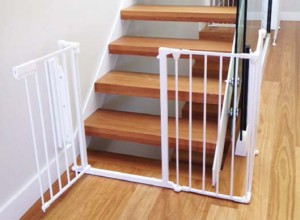 Stairs in older homes often do not comply with current safety requirements. Every year in Australia an estimated 50,000 children are treated in hospital for fall injuries that occur in the home; some of the most serious of these are stair falls. Horizontal stair balustrades promote climbing. Vertical balustrades and treads with gaps exceeding 125mm are serious entrapment hazards or allow potential falls. In these instances, protective measures need to be taken. These are usually specific to each situation. Homesafe Kids can advise on this. Ideally, stairs should be isolated with child resistant gates. The Homesafe Kids website has photographs of typical stair applications.
Note: Injury data for Australia has been estimated from Victorian injury data provided by the Victorian Injury Surveillance Unit (VISU) at Monash University Injury Research Institute (MIRI), Homesafe Kids and Kidsafe then estimated for Australia on a pro rata population basis.
For more information on having a home assessment, please contact us.